The bigger picture
Real science, real people
Peptides are among the most-studied molecules in modern research — the science behind the tools on this page.



Free peptide tools
Reconstitution and dosing math, done for you — plus plain‑English guides on handling, storage, and the mg/mcg/units confusion that trips everyone up.
Vial mg, water, and dose in — exact syringe units out, with a live insulin‑syringe preview.
The bigger picture
Peptides are among the most-studied molecules in modern research — the science behind the tools on this page.
The basics
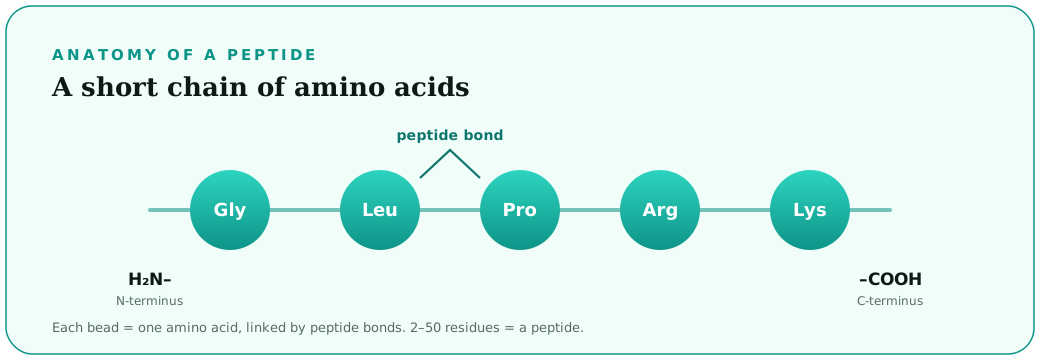
A short chain of amino acids — the same building blocks as proteins. That's the whole idea behind the reconstitution math and the numbers below.
The 90-second version
Lyophilized (freeze‑dried) peptide is a powder. You turn it into an injectable solution by adding bacteriostatic water — that's it. The order matters more than the speed.
Let the peptide vial and the bacteriostatic water sit out for a few minutes. Wipe both stoppers with an alcohol swab.
Draw your chosen volume of BAC water and let it run down the glass wall — never jet it straight onto the powder.
Roll the vial gently until clear. Shaking foams and can shear fragile peptide chains. Give it a minute if needed.
Refrigerate at 2–8 °C. Use the calculator above to convert your dose in mcg to units on the syringe.
The #1 mistake
A dosing error is almost always a units error. Milligrams (mg) and micrograms (mcg) measure the peptide; “units” are just marks on the syringe barrel. Here's how they line up.
| Your dose | Volume | On the syringe |
|---|---|---|
| 100 mcg | 0.04 mL | 4 units |
| 250 mcg | 0.10 mL | 10 units |
| 500 mcg | 0.20 mL | 20 units |
| 1 mg (1000 mcg) | 0.40 mL | 40 units |
Most peptide doses are written in mcg. If a protocol says “250 mcg,” that is 0.25 mg — a quarter of a 1 mg amount, not 250 of anything on the syringe.
A U‑100 insulin syringe has 100 units per mL. Units only tell you how far to pull the plunger — the actual peptide you get depends entirely on how you mixed the vial.
More tools
Two more research-use tools: plan how long a vial lasts across a protocol, and split a multi-peptide blend into per-component draws. Educational reference only.
Learn more
Handling basics, plus in-depth research references on 30+ research-use peptides, each one sourced. New entries added regularly.
Handling & basics
Why BAC water (0.9% benzyl alcohol) is standard for multi‑dose vials, and when sterile water is used instead.
NIH · DailyMed ↗ GuideLyophilized vs. reconstituted, fridge vs. freezer, and how long a mixed vial actually lasts.
NIH · PubMed Central ↗ ReferenceU‑100 units explained, gauge vs. length, and reading the barrel without second‑guessing.
NIH · NCBI Bookshelf ↗ ToolThe interactive tool up top — vial mg, water, dose in, units out, with a live syringe preview.
Open tool → ExplainerA plain‑language primer on peptide chains, common classes, and how they're studied.
NIH · StatPearls ↗ ReferenceSwab, single‑use needles, and the small habits that keep a vial clean through every draw.
WHO · via NIH ↗In-depth, sourced monographs grouped by research area — growth hormone & IGF, repair & recovery, metabolic, cognitive, longevity, hormonal, and skin.
You've got the math. Get research‑grade peptides and bacteriostatic water from MyPeptide — with a COA on every batch.